

When the End of the World Looks Like Delhi: Reading Climate Apocalypse Through All Quiet in Vikaspuri
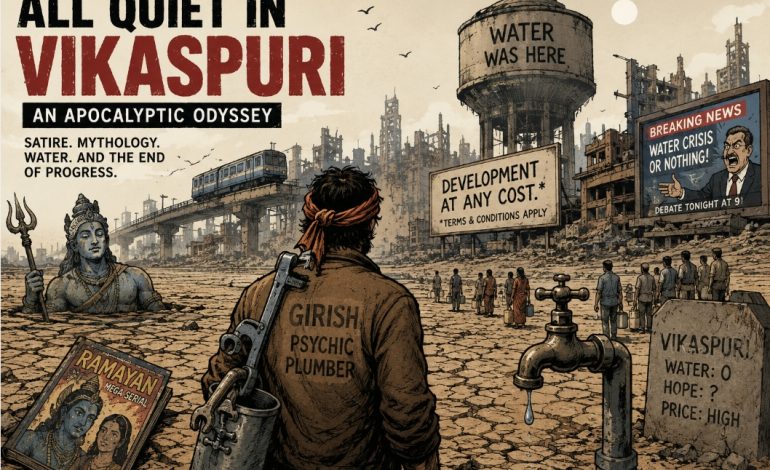

What does the Climate Apocalypse look like if it unfolds not in New York, London, or a futuristic dystopian metropolis, but in Delhi—a city where water is more valuable than gold, television debates drown out real crises, and mythology coexists with urban decay?
For decades, stories about climate catastrophe have relied on a familiar formula. Towering floods, scorched landscapes, collapsing civilizations, and desperate survivors dominate popular imagination. Yet these narratives have largely emerged from Western perspectives, presenting the apocalypse through a distinctly Eurocentric lens. The question that often remains unanswered is simple: What does climate collapse look like from South Asia?
Sarnath Banerjee’s graphic novel All Quiet in Vikaspuri offers a striking answer. Rather than presenting the end of the world through spectacular destruction, Banerjee imagines a Delhi quietly crumbling under an acute water crisis. The city is not destroyed overnight; instead, it slowly withers beneath the weight of environmental neglect, political indifference, privatized resources, and relentless capitalism. The apocalypse here is not a distant future—it feels unsettlingly familiar.
A Different Kind of Apocalypse
Unlike conventional climate fiction, All Quiet in Vikaspuri refuses to overwhelm readers with cinematic disaster. Its post-apocalyptic landscape is almost absurd. The narrative drifts through the lives of people from different social backgrounds, assembling a fragmented portrait of a city that has normalized ecological collapse.
At the center of this unusual journey stands Girish, the psychic plumber introduced in Banerjee’s earlier work Harappa Files. His search for the mythical underground river Saraswati resembles an ancient odyssey transplanted into the Anthropocene. Instead of slaying monsters, Girish navigates bureaucracy, misinformation, urban decay, and collective denial.
His quest becomes symbolic of something larger—the search for hope in a civilization that has forgotten how to value its most essential resource.
Laughing at the End of the World
Perhaps the novel’s greatest strength lies in its refusal to be solemn.
Climate change is typically narrated through fear, grief, and impending doom. Banerjee, however, employs satire, irony, and deadpan humor. Television dramas, cricket references, Hindu mythology, and pop culture collide with environmental collapse, producing moments that are simultaneously hilarious and deeply unsettling.
This comic tone is not a dismissal of ecological crisis. Instead, it functions as a powerful literary strategy. In an age where audiences have grown numb to endless warnings about climate disaster, humor cuts through emotional fatigue. By making readers laugh, Banerjee also forces them to confront uncomfortable truths about their own society.
Drawing Disaster Without Spectacle
The visual language of All Quiet in Vikaspuri is equally unconventional.
Its illustrations are deliberately sparse and understated. Rather than depicting catastrophic destruction in painstaking detail, Banerjee leaves gaps, silences, and empty spaces between panels. These visual absences invite readers to participate in constructing the world themselves.
The result is an apocalypse that feels disturbingly ordinary. Disaster is not spectacular—it is mundane. It unfolds in familiar neighborhoods, ordinary conversations, and everyday routines. This restraint makes the environmental crisis more intimate and, paradoxically, more frightening.
The Politics Beneath the Parody
Beneath its humor and seemingly casual storytelling lies a sharp political critique.
The novel exposes how environmental degradation is intertwined with unchecked capitalism, urban expansion, media sensationalism, and the privatization of natural resources. Water scarcity is not portrayed as an inevitable natural disaster but as a consequence of human choices and political priorities.
Delhi becomes more than a setting. It transforms into a metaphor for modern cities that celebrate development while quietly exhausting the ecosystems that sustain them.
In Banerjee’s world, progress itself becomes suspect.
Rethinking the Anthropocene from India
One of the most significant contributions of All Quiet in Vikaspuri is its ability to reimagine the Anthropocene through Indian cultural memory.
Instead of borrowing Western symbols of apocalypse, Banerjee draws upon local mythology, urban folklore, history, and everyday life. The mythical Saraswati River, popular media, neighborhood politics, and Delhi’s lived geography collectively construct an environmental narrative rooted in South Asian experience.
This localization matters.
Climate change is global, but its stories should not all sound the same. Every region experiences ecological crisis through its own history, culture, and social realities. Banerjee demonstrates that environmental storytelling becomes richer—and perhaps more truthful—when it speaks in local voices rather than universal clichés.
Why This Graphic Novel Matters Today
As water scarcity intensifies across Indian cities and conversations around climate justice become increasingly urgent, All Quiet in Vikaspuri feels less like speculative fiction and more like social commentary.
Its greatest achievement is not predicting the future but revealing the present. It reminds us that apocalypse does not always arrive with explosions or collapsing skylines. Sometimes it appears gradually—in empty reservoirs, disappearing rivers, political apathy, and citizens who continue with everyday life despite everything falling apart.
By blending mythology, satire, visual experimentation, and ecological criticism, Sarnath Banerjee creates a graphic narrative that challenges dominant climate narratives while expanding the possibilities of Indian environmental literature.
Perhaps the most unsettling realization the novel leaves us with is this: the apocalypse may not be something we are waiting for.
It may already be quietly unfolding around us.
Chandra, S. 2026
References
Banerjee, Sarnath. 2015. All Quiet in Vikaspuri. Noida: Harper Collins.
Mandhwani, Aakriti. 2016. “All quiet in Vikaspuri.” South Asian Popular Culture 14, no. 1-2
(2016): 126- 28. https://doi.org/ 10.1080/14746689.2016.1241350.



1 Comment
[…] यही बेचैन करने वाला, लेकिन हँसी में लपेटा हुआ सच सामने लाती है सारनाथ बनर्जी की ग्राफिक कथा All Quiet in Vikaspuri। […]