

When Grief Defies Fate: How The Epic of Gilgamesh and Antigone Invented the Tragic Human Condition
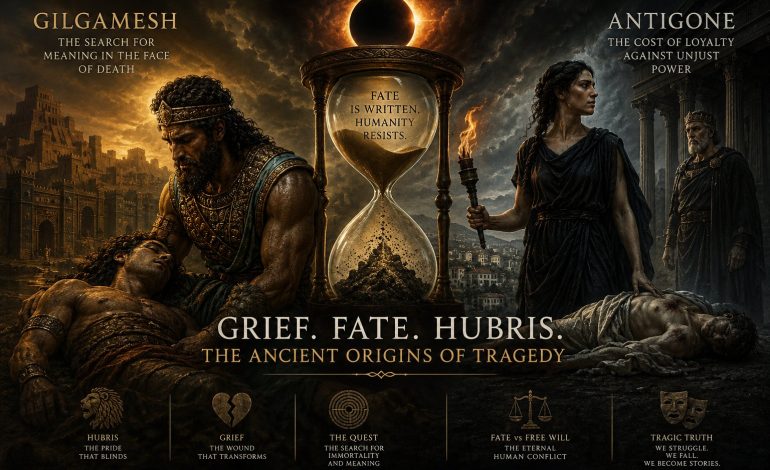

Before modern psychology named grief.
Before philosophy theorized existential despair.
Before Greek tragedy perfected the art of human suffering—there was Gilgamesh.
Across the deserts and riverbanks of ancient Mesopotamia emerged a story that would become one of humanity’s earliest meditations on death, power, love, pride, and fate. The Epic of Gilgamesh is not merely an ancient myth etched into clay tablets; it is the primordial blueprint of tragic consciousness itself. Long before Sophocles wrote Antigone, Gilgamesh had already confronted the terrifying paradox that would haunt Greek tragedy: human beings possess extraordinary will, yet remain helpless before mortality.
In many ways, The Epic of Gilgamesh synthesizes the martial grandeur of The Iliad with the spiritual wandering of The Odyssey. But unlike either text, Gilgamesh turns inward. It becomes meditative, philosophical, and deeply existential. The epic wrestles with questions that continue to disturb humanity even today:
What is the purpose of power if death annihilates all achievements?
Can grief transform identity?
Is rebellion against fate heroic—or futile?
These questions become the philosophical bedrock upon which Greek tragedy would later stand.
The Birth of the Tragic Hero
The figure of Gilgamesh inaugurates one of literature’s most enduring archetypes: the tragic hero.
Like the later protagonists of Greek tragedy, Gilgamesh possesses what Aristotle would eventually call hamartia—a fatal flaw embedded within greatness itself. He is powerful, magnificent, and godlike, yet deeply flawed by arrogance, excess, and restless ambition. His flaw is not weakness; it is the dangerous intensity of greatness.
This same tragic architecture reappears centuries later in Antigone.
The worlds of Gilgamesh and Antigone are governed by a terrifying cosmic tension: the collision between human agency and inevitable fate. In both narratives, individuals push against limits imposed by mortality, divine order, and political authority. Yet their resistance carries catastrophic consequences.
Gilgamesh seeks immortality after the death of Enkidu.
Antigone seeks moral immortality through loyalty to her dead brother Polynices.
Both journeys are acts of defiance against the structure of existence itself.
Hubris: The Ancient Disease of Power
At the center of both texts lies hubris—overwhelming pride born from authority.
Gilgamesh begins as a tyrannical ruler intoxicated by his own power. His kingship grants him political dominance, masculine authority, and near-divine status. Similarly, Creon, the ruler of Thebes in Antigone, believes that political law must supersede all moral and spiritual obligations.
Both men confuse authority with absolute truth.
Yet their trajectories diverge dramatically.
Gilgamesh survives his downfall. Through suffering, he acquires wisdom. His confrontation with death teaches him humility and compassion:
“Do not be haughty and unjust, but rather a shepherd to your people.”
The tyrant becomes human through grief.
Creon, however, never truly transcends his hubris. His stubborn insistence on obedience destroys everything around him. Even when warned by Tiresias and challenged by his own son Haemon, Creon remains trapped within the prison of power. He weaponizes authority against dissent, accusing Tiresias of corruption and Haemon of becoming “the slave of a woman.”
His downfall is not merely political—it is existential.
Unlike Gilgamesh, Creon learns too late.
Antigone and Gilgamesh: The Sacred Language of Grief
What makes these texts timeless is not simply their exploration of power, but their devastating understanding of grief.
When Enkidu dies, Gilgamesh collapses psychologically. The mighty king becomes almost animalistic in mourning:
“He began to rage like a lion, like a lioness robbed of her whelps.”
He tears his clothes. He wanders aimlessly. He neglects himself. He sits beside Enkidu’s corpse for days until decay physically forces him to confront mortality.
This is not abstract sorrow. It is raw human devastation.
Gilgamesh’s grief becomes transformative because it strips away illusion. For the first time, he realizes that strength cannot conquer death. His quest for immortality is ultimately an attempt to escape emotional annihilation.
And here, astonishingly, Gilgamesh mirrors Antigone.
Antigone’s determination to bury Polynices is not simply political resistance—it is grief transformed into sacred duty. Her loyalty transcends state law because mourning itself becomes holy. To abandon her brother’s body would mean betraying love, memory, and kinship.
Like Gilgamesh, Antigone cannot tolerate the desecration of the dead.
Both characters are consumed by attachment to those they have lost.
Both resist systems larger than themselves.
Both turn grief into rebellion.
Yet while Gilgamesh survives to narrate wisdom, Antigone’s grief culminates in self-annihilation.
The Existential Crisis at the Heart of Civilization
What makes these ancient texts revolutionary is their recognition that civilization itself is built upon unresolved contradictions.
Human beings seek permanence in a temporary world.
They desire control within a universe governed by uncertainty.
They construct kingdoms, laws, monuments, and moral systems to resist chaos—yet death eventually dismantles all structures.
Gilgamesh discovers that immortality belongs only to stories.
Creon discovers that law without humanity becomes violence.
Antigone discovers that moral conviction can demand self-sacrifice.
These are not merely literary lessons; they are ontological revelations about what it means to exist.
Mysticism, Fate, and the Cosmic Order
Both The Epic of Gilgamesh and Antigone also operate within a symbolic universe infused with theological and mystical dimensions.
Gilgamesh’s journey resembles an esoteric initiation. He descends psychologically into the unknown, encounters divine figures, survives supernatural trials, and returns transformed. His quest reflects humanity’s ancient obsession with transcending mortality through spiritual knowledge.
Similarly, Antigone occupies a liminal space between mortal law and divine justice. Her actions are guided not by political logic but by an unwritten sacred order that supersedes kingship itself.
In this sense, both texts become allegories of spiritual confrontation.
The heroes stand between two worlds:
- the temporal and the eternal,
- human law and cosmic law,
- mortality and transcendence.
Their suffering acquires metaphysical significance.
Why These Ancient Texts Still Matter
Thousands of years later, Gilgamesh and Antigone remain painfully contemporary because modern humanity continues to grapple with the same existential dilemmas.
We still fear death.
We still confuse power with permanence.
We still search for meaning within suffering.
We still struggle between obedience and conscience.
Ancient literature survives because it reveals truths that civilization cannot outgrow.
Gilgamesh teaches that grief can humanize power.
Antigone teaches that moral courage may demand destruction.
Creon teaches that authority without humility leads to catastrophe.
Gilgamesh’s experience and understanding of human grief aligns with the contemporary understandings of human emotions and its complexities. Immediately after being cognizant about Enikdu’s death, Gilgamesh finds himself trapped in a complex web of emotions; “began to rage like a lion, like a lioness robbed of her whelps. This way and that, he paced round the bed, he tore out his hair and strewed it around. He dragged off his splendid robes and flung them down as though they were abominations.”
Herein one can witness the deep depression following Gilgamesh as he sits with Enkidu’s corpse for a week, neglecting himself. He only leaves when the body shows signs of decomposition. In order to avoid a confrontation with his inner turmoil, Gilgamesh embarks on a quest to achieve immortality in order to defeat death. Herein, Gilgamesh’s stern resolve and his sense of mourning for his beloved companion Enikdu quite aptly aligns with Antigone’s agony as she struggles to cremate the body of her beloved brother.
Together, these texts expose the tragic structure of human existence itself: we are beings capable of extraordinary love, ambition, and resistance, yet doomed by mortality and limitation.
And perhaps that is why these stories continue to haunt us.
Because beneath the myths, the gods, the kingdoms, and the prophecies, Gilgamesh and Antigone are ultimately confronting the same unbearable truth:
To be human is to struggle against inevitability while knowing defeat is certain.
References
Abusch, T. 2015. 6. The Development and Meaning of the Epic of Gilgamesh: An Interpretive Essay. Male and Female in the Epic of Gilgamesh: Encounters, Literary History, and Interpretation. University Park, USA: Penn State University Press, pp. 127-143. https://doi.org/10.1515/9781575067186-009
Agard, Walter R. “Fate and Freedom in Greek Tragedy.” The Classical Journal, vol. 29, no. 2, 1933, pp. 117–26. JSTOR, http://www.jstor.org/stable/3290417. Accessed 20 Oct. 2023.
George, Andrew, et al. The Epic of Gilgamesh. Translated by Andrew George, Penguin Classics, 2003.
Sophocles. Antigone. Translated by David Mulroy, University of Wisconsin Press, 2013. ProQuest Ebook Central, ebookcentral.proquest.com/lib/sccsc/detail.action?docID=3445283.




1 Comment
[…] Source: When Grief Defies Fate: How The Epic of Gilgamesh and Antigone Invented the Tragic Human Condition […]