

how concepts of social class and race were interconnected in colonial Victorian England?
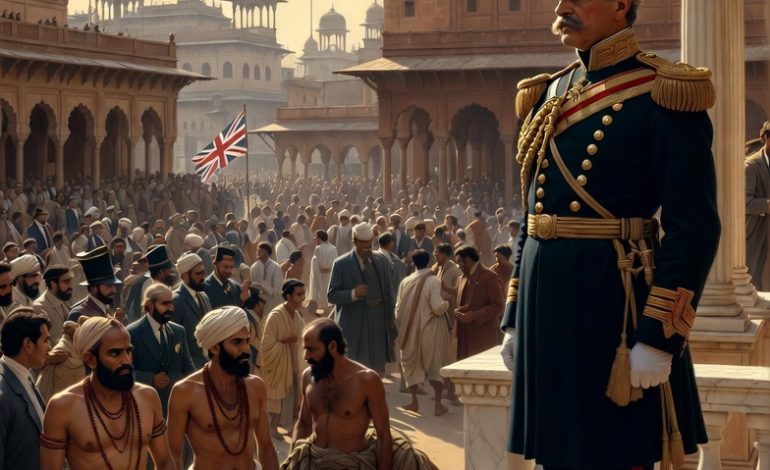

Population movement was a prominent aspect of the post-enlightenment, post-French Revolution era of national integration and imperialism that followed the British territorial expansion and achievements of 1815. The augmented mobility of the populations and their agglomeration in the urban centers were distinctive features of 19th century British identity, stimulated by the Industrial Revolution’s mass production of wealth, by the massive network of slave trade and concomitantly by the colonial expansion. This intrinsic fluidity instilled in the innate character of 19th century British consciousness inevitably compelled the Victorians to experience a much more enriched form of regional, religious, racial and national multiplicity. This invigorating sense of multitude in terms of the population symmetry of Britain invited the Victorian writers to further integrate this binary of “self” in opposition to the “other” in multifarious ways.
Edwaid Said adduces that by perceiving a novel with a contrapuntal lens, one can take into consideration the intertwined and enmeshed histories and perspectives. Precisely, contrapuntal analysis assists in interpreting texts, taking into consideration the perspectives of both the ‘colonizer’ (self) and the ‘colonized’ (Other) (Said; 61). This approach is instrumental in making necessary connections within the narratorial scaffold of a novel. Interpreting contrapuntally is inferring diverse standpoints simultaneously and thus discerning how the larger text interacts with itself as well as with the historical or biographical contexts. It is reading with “awareness both of the metropolitan history that is narrated and of those ‘other’ histories against which the hegemonical discourses acts (Said; 51)”. Said further argues that with the economic, territorial and political expansion of the Empire, the British psyche assumed a moral and cultural responsibility to civilize the barbarians of the conquered territories. The British consciousness thus “othered” the populace of these colonies putting them on the peripheries and steep end of the social hierarchy. Therein, contrapuntal understanding of the texts necessitates an imperative vision in which imperialism and literature are perceived collectively. Charlotte Bronte’s Jane Eyre works with a similar nexus of diverse strains of ‘otherness’ (class consciousness, colonist impulses, imperialism and gender discourses) to construe the larger socio-political understanding of the Victorian society. This paper therein delves deeply in understanding the inter-sectionality of the various divarications of “otherness” within Bronte’s Jane Eyre. This paper concomitantly employs the post-colonial literary analysis theory of contrapuntal reading while examining Bronte’s novel, which interrogates the contextual background of a text’s creation, which Said propounds in his theory of Orientalism.
Precisely, Victorian critics have been conscious that the Victorian writers and readers did not encompass a unified cadaver. Histories like E.P Thompson’s The Making of the English Working Class (1966) assist to nuance awareness of Victorian class divisions. Steven Marcus’s The Other Victorian (1966) is essential to dispel the notion that Victorian’s held common consensus on the grounds of sexual prudishness. During the 1970s, Gilbert and Gubar’s Madwoman in the Attic (1979) proffered an increasingly enriched understanding and analysis of Victorian womanhood and thus provided prominent insights on the period’s representation of gender. But the equally convoluted representation of racial, ethnic, religious and regional “others” have received myopic understanding and less diverse analysis. It thus becomes imperative to understand the inherent conceptualization of “otherness” in order to further interrogate the larger representation of the “othered” entity in the Victorian literary corpus.
Cultural geographer Crang (Crang: 61) describes othering as”a process through which identities are set up in an unequal relationship”. Othering is the simultaneous construction of the self or in-group and the other or out-group in mutual and unequal opposition through identification of some desirable characteristic that the self has and the other lacks. Othering thus sets up a superior self/in-group in contrast to an inferior other/out-group, but this superiority/inferiority is nearly always left implicit.
Victorian “others” comprised of marginalized groups whose combined identity was conceived to vary in fundamental ways from the white, Protestant, English-speaking Victorian mainstream population. Majority of writers assumed a group’s otherness as an ineffaceable obstruction to its reception of full rights and civil liberties. This perceptual hurdle was reinforced by policies, economic and political restrictions, social scientific reports, Darwinian racial rankings and predominantly by the portraiture and representations of “others” within the larger literary gamut of novels, poetry and drama.
Charlotte Bronte significantly incorporates varied streams of “otherness” precisely social class divide, colonist impulses and gendered social identity construction through the faculty of her characters. Jane Eyre posits herself as an unconventional protagonist, who belongs to the working class. Jane Eyre’s discernment that she is a foreigner whom Mrs. Reed could not perhaps relate to, the inherent idea that Mrs. Reed perceives her as “an interloper, not of her race (7)” reflects Bronte’s use of allusions to colonized races to connote a variety of social positioning in the British societal structure. It becomes essential to acknowledge that jane’s attribution as a “foreigner”, the denial of her national identity amplifies the marginality quotient in her character. Race intertwined with class offers a complicated concoction of “otherness” which is habitually employed by Mrs. Reed to deny fundamental dignity to Jane. The female subjugation in sexual affairs, female rebellion and angst against the phallic-centric power centre, and the repeated dehumanization of the working classes akin to the colonized masses find resonances in the character of Jane Eyre. From the beginning of the narrative, there’s an innate tendency of the Reeds to dehumanize Jane by constantly comparing her to an animal. “Joan is not here: tell mama she is run out into the rain- bad animal! (3)”, herein John Reeds, Jane’s cousin labels Jane as an animal which depicts the commonly held understanding of the working classes within the social fabric of 19th century England. By ascribing the innate animalistic description with Jane’s identity, her mannerism – The Reeds from the beginning of the narrative brackets her as an “othered” individual. Edmund Burke in relation to the working classes first utilized the term “Swinish Multitude” in 1790 in his Reflections on the Revolution in France. Although he employed the term in order to articulate his apprehension about the future of culture in France. He envisaged that the destruction of the nobility and the clergy – the traditional benefactors of knowledge would be followed by the devastation of learning itself, which he adduced would be “cast into the mire and trodden under the hoofs of a Swinish multitude (Bartel, 4-9).” The English radicals and supporters of the rights of working classes deduced this term as a derogatory remark for the working classes, reducing them to the level of animals and thus ripping them of humanity, dignity and most imperatively denying them of civil liberties. Therein, the reduction of Jane to a savage animal along with the construal of her strength to defend herself as a mere “animalistic passion” potently comments on the larger socio-political condition of the working classes in 19th century Britain.
Bertha Mason, a creole woman hailing from the British colonies in the West Indies, assumes a pivotal role as the hysteric wife of Mr. Rochester. The mechanism of “othering” in relation with Bertha Mason’s character assumes a more convoluted character. Spivak argues that the text offers emancipation to Jane on the cost of Bertha. In a significant interpretation of the importance of colonialism in Jane Eyre, Spivak opines that “the uninterrogated ideology of imperialist axiomatic, reviews the narrative of Bronte by facilitating the idiosyncratic social growth of the character of Jane which has been distinguished by mainstream feminists.” Her appraisal documents Bertha as a “white Jamaican Creole” who can be witnessed in Jane Eyre as a “native subject,” undeterminably stationed between human and animal and consequently debarred from the humanity which Jane Eyre proffers to Jane. Spivak’s analysis of the coordinates of otherness in relation to Bertha and Jane again espouses a sense of primal humanity allowed to Jane due to her national identity, even if her class status denies her certain privileges and liberties. But in the case of Bertha, the myriad form of marginality completely debauches all the possibilities for social growth and progression. Bronte in Jane Eyre responds to the ostensibly avoidable equivalence in 19th century British texts that compares white women with “blacks” as an mechanism to demean both the “othered” groups. Bronte employs the analogy in Jane Eyre for her own reasons, in order to denote not collective lowliness but collective subjugation (Bhowmick P, Mandal P & Roy D; pp 196-197). This metaphorical stratagem stimulates some sympathy with blacks as those who are marginalized, but it does not completely disqualifies or condemns racism. Jane Eyre for the larger part suppresses the disparaging history of slavery and bigoted subjugation, its conclusion betrays a concern that colonialism and the suppression of the voices of the other races tarnish the English history and that the narrative’s individual application of the racial “other” for symbolic purposes involves a problematic semblance to that history. Therein, one can argue that the view point Jane Eyre takes towards imperialism is Eurocentric and conformist. An understanding of the ramifications of the British colonial Empire in Jane Eyre commences with the construal of the identity of Bertha Mason, whom Rochester keeps trapped on the third floor of his manor at Thornfield. Bertha functions in Jane Eyre as the central point of Bronte’s consternation about cruelty, becoming symbolic of the obstacles which Mr. Rochester and Jane encounters on their way towards a happy union. Bertha comes into the larger frame of the novel, only after about a third of its accomplishment has taken place. As her character becomes visible, the problems and the obstacles which were earlier situated elsewhere rather conspicuously embodied by the character of Jane herself become federalized and concretized in the figure of Bertha.
We read Bertha’s anomalous haziness of race a haziness which is manifested inside the text itself, rather than one which requires to be mapped onto it — as unswervingly inter connected to her role as a spokesperson of dangers which intimidate the topography of Jane Eyre. She is the heiress to a West Indian fortune, the offspring of a father who is a West Indian planter and trader, and the sister of the yellow-skinned hitherto communally white Mr. Mason. She is also a lady whom the younger son of an upper-class British kin would deem wedding, and so she is unmistakably fantasized as white — or as fleeting as white — in the novel’s backward-looking narrative. The critics of Jane Eyre have time and again whispered that Bertha is a white lady, basing the hypothesis on this fraction of the storyline, even though Bertha has often been sketched as a “swarthy” or “dark” white lady. But when she essentially emerges in the route of the action, the narrative links her with blacks, predominantly with the black Jamaican antislavery rebels, the Maroons. In the appearance in which she becomes noticeable in Jane Eyre, Bertha has become black as she is constructed by the sequence of events, much like Matilda Fitzgibbon becomes black in Emma. Yet in Rochester’s version of the time before their wedding ceremony, when Bertha Mason was “a fine woman, in the style of Blanche Ingram: tall, dark, and majestic,” there are clues, as there are in the early images of Matilda Fitzgibbon, of the uncertainty of her race. Instantaneously after Rochester delineates Bertha as “tall, dark, and majestic,” he continues: “her family wished to secure me because I was of a good race” (p. 322). In the milieu of a colony where blacks surplus whites by twelve to one, where it was a custom and time-honoured exercise for white planters to compel female slaves to develop into their “concubines,” and where whites were subsequently worriedly conscious of the huge population of mulattoes, Rochester’s slogan accrues importance beyond its instantaneous orientation to his old family name. In this framework the slogan suggests that Bertha herself may not be of as “good” a race as he.” Bertha is the offspring, as Richard Mason incongruously and it seems that gratuitously declares in his official testimony to her wedding with Rochester, “of Jonas Mason, merchant, and of Antoinetta Mason, his wife, a Creole” (p. 318).The haziness of Bertha’s race is noticed by this labelling of her mother as a “Creole. When Rochester exclaims of Bertha that “she came of a mad family; idiots and maniacs through three generations! Her mother, the Creole, was both a madwoman and a drunkard!” he posits both insanity and inebriation in his spouse’s maternal line, which is again vigorously and obscurely, pigeonholed “Creole.” By doing so, he links that line with two of the most familiar stereotypes connected to blacks in the nineteenth century. As Bertha comes out as a character in Jane Eyre, her blackness is made more unambiguous, regardless of Rochester’s desire to persuade Jane, and possibly momentarily himself, that “the swelled black face” and “exaggerated stature” of the lady she has seen are “figments of imagination, results of nightmare” (p. 313). But when Jane starts detailing to Rochester the face she has seen reflected in the emulate, the topoi of racial “otherness” are very palpable: “Fearful and ghastly to me — oh sir, I never saw a face like it! It was a discoloured face — it was a savage face. I wish I could forget the roll of the red eyes and the fearful blackened inflation of the lineaments!” “Ghosts are usually pale, Jane.” “This, sir, was purple: the lips were swelled and dark; the brows furrowed: the black eyebrows widely raised over bloodshot eyes.” (p.311). The importance on Bertha’s colouring in this passage — she is ardently not “pale” but “discoloured,” “purple,” “blackened” — the indication to rolling eyes and to “swelled,” “dark” lips all tenaciously and stereotypically blotch Bertha as non-white. Jane’s use of the word “savage” suggests the insinuation of her explanation of Bertha’s characteristics, and the rosiness which she sees in Bertha’s rolling eyes suggests the inebriation which, triumphing the familiar racist principle, Bronte has allied with blacks since her early days. As Bertha’s “lurid visage flame[s] over Jane” while she slanders in bed, causing her to mislay awareness, the vaguely dark blood Bertha has inherited from her
John Eyre, Jane’s uncle and St. John Rivers further embodies the colonizer’s impulse. Both the characters are symptomatic of the incessant desire of the white man to extract fortune through the faculty of colonialism. Moreover, it becomes imperative to discern that through the character of St. John, Bronte divulges the white man’s innate ambition of attaining both economic wealth and cultural prowess through the institution of colonialism. St. John does not plainly intends to extract wealth from his intention of moving to India as a missionary but one can perceive an impulse of imposing the dictates of the white man, his religion onto the barbarians. The cautious character deployment is largely symptomatic of the amplified sense of public consciousness about the Empire’s involvement in colonialism and slave trade. Despite marginalized and sporadic voices of protest raised by abolitionists in Britain – predominantly coupled with campaigns for women’s emancipation – one can perceive the focal position of the dominant, imperialist ideology of the era alongside its societal ramifications, such as amplified national pride, colonial ambition and the profound belief in racial hierarchies in the ambit of 19th century British literature.
Chandra, S. 2026
References and citations
- “The Others in Charlotte Brontë’s Jane Eyre: A Postcolonial-Orientalist and Feminist Reading” Social Sciences University of Ankara, Faculty of Foreign Languages Department of English Language and Literature, 2019. filiz.barinakman@asbu.edu.tr
- Bartel, Roland. “Shelley and Burke’s Swinish Multitude.” Keats-Shelley Journal, vol. 18, 1969, pp. 4–9, http://www.jstor.org/stable/30212678. Accessed 20 Apr. 2022.
- Bhowmick P, Mandal P & Roy D. “Jane Eyre and its Heteroglossia, Colonialism, Class Struggle, Racial Otherness and the Significance of the British Empire” International Journal of English, Literature and Social Sciences (IJELS) Vol-5, Issue-1, Jan – Feb 2020 https://dx.doi.org/10.22161/ijels.51.3
- Elliott, Dorice Williams. “Servants and Hands: Representing the Working Classes in Victorian Factory Novels.” Victorian Literature and Culture, vol. 28, no. 2, 2000, pp. 377–90, http://www.jstor.org/stable/25058525. Accessed 19 Apr. 2022.
- Galchinsky M. “Otherness and Identity in the Victorian Novel” Georgia State University,2002 mgalchinsky@gsu.ed
- E, “Culture and Imperialism”. London. Vintage.1993.




1 Comment
[…] contrast is particularly significant. Without necessarily endorsing communal ideology, Desai inadvertently reproduces a historical narrative in which Hindu culture appears eternal while […]