
The Algorithm and the Altar: Is Social Media Creating a New Religion?
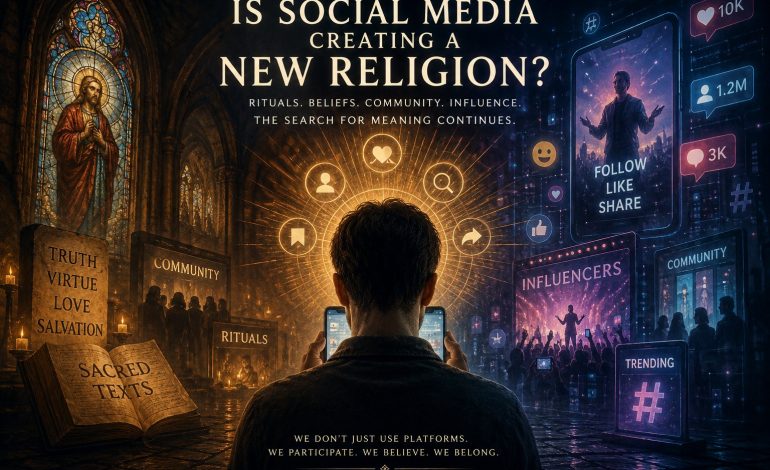

We No Longer Look Up. We Look Down.
A thousand years ago, people woke to the ringing of church bells, the call to prayer, the chanting of monks, or the recitation of sacred texts in temples. Their days were structured by rituals that connected them to something larger than themselves.
Today, many of us begin the morning with a different ritual.
Before our feet touch the floor, before we speak to another human being, before we confront the reality of the day, we reach for our phones.
We scroll.
What appears to be a mundane habit raises a profound question: if religion has historically organized human meaning, identity, morality, and community, what happens when social media begins performing those same functions?
The question is not whether social media is a religion in the traditional sense. It is not. There are no universally recognized gods, no sacred scriptures handed down from antiquity, no formal theology.
Yet the deeper question remains unsettling:
Has social media become a substitute for religion in modern society?
The Human Need for the Sacred
To understand the rise of social media, we must first understand why religion exists.
The sociologist Émile Durkheim argued that religion is not primarily about gods. At its core, religion is a social institution that creates collective meaning.
In The Elementary Forms of Religious Life, Durkheim proposed that societies divide the world into two categories:
- The sacred
- The profane
The sacred consists of objects, symbols, rituals, and beliefs invested with special significance. The profane encompasses ordinary everyday life.
Religion, in this view, is less about heaven than about community. Through rituals and symbols, individuals experience what Durkheim called collective effervescence—the feeling of belonging to something greater than oneself.
For centuries, religions fulfilled this need.
But modernity changed the landscape.
As traditional religious participation declined across many societies, the human need for belonging did not disappear. The desire for meaning did not vanish. The hunger for transcendence remained.
The question became: where would these needs migrate?
The Digital Cathedral
Enter social media.
Platforms such as Instagram, TikTok, X, YouTube, and Facebook were designed as communication technologies. Yet they have evolved into something far more influential.
Like religious institutions, they shape how people understand reality.
Like sacred spaces, they gather communities around shared beliefs.
Like rituals, they structure daily behavior.
Like myths, they tell stories about who we are and who we ought to become.
The philosopher Charles Taylor describes modern life as existing within an “immanent frame”—a world increasingly detached from transcendent explanations.
Yet human beings continue seeking significance.
Social media offers a powerful answer.
Not transcendence beyond the world.
Transcendence through visibility within it.
The New Rituals
Religions survive through repeated practices.
Prayer.
Pilgrimage.
Fasting.
Confession.
Communion.
Rituals are not merely symbolic acts; they shape identity through repetition.
Social media possesses its own ritual architecture.
Morning scrolling.
Checking notifications.
Posting updates.
Monitoring engagement.
Refreshing feeds.
The anthropologist might observe that these actions function similarly to religious rituals because they are repeated, emotionally charged, and socially reinforced.
Each notification resembles a tiny affirmation.
Each like becomes a form of recognition.
Each share confirms one’s place within a community.
The behavior often feels voluntary.
The compulsion suggests otherwise.
The Algorithm as an Invisible God
Traditional religions often posit an unseen force that orders reality.
The divine may be invisible, but its influence is believed to permeate everyday life.
Social media introduces a different invisible force: the algorithm.
Few users understand precisely how it works.
Yet everyone adjusts behavior in response to it.
Creators speculate about its preferences.
Influencers attempt to appease it.
Businesses depend upon its favor.
Entire careers rise and fall according to its judgments.
The algorithm is not conscious. It possesses no will.
Yet functionally, it occupies a curious cultural position.
It is unseen.
Its decisions shape lives.
Its logic remains mysterious.
And millions modify their behavior in hopes of receiving its blessings.
Saints, Prophets, and Influencers
Figure 1: social media influencer: a new prophet
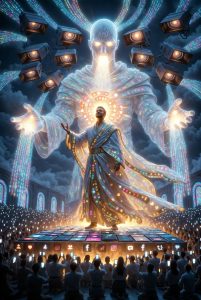
Every religion elevates exemplary figures. Saints embody virtue. Prophets communicate truth. Spiritual leaders interpret reality.
Digital culture has developed analogous figures. Influencers serve as moral guides, lifestyle models, political interpreters, and identity architects. Followers do not merely consume their content but they imitate them as well.
The literary critic René Girard offers a useful framework here. Girard argued that human desire is fundamentally mimetic. We desire things because other people desire them. The object itself matters less than the model who desires it. Social media industrializes mimetic desire.Every feed becomes a catalog of lives to emulate. Every influencer becomes a potential object of imitation. In this sense, platforms transform aspiration into a permanent social environment.
The Gospel of Self-Creation
The “gospel” often revolves around popularity, authenticity, outrage, progress/justice narratives, or self-optimization. In the contemporary social media age, fame or virality is the highest good; influencers are prophets or saints. Cancel culture acts as excommunication.
Many traditional religions teach that identity is discovered through obedience to a transcendent order. However, social media has championed a different doctrine. Identity becomes a project. The self becomes a brand. Authenticity becomes performance.
The philosopher Friedrich Nietzsche famously proclaimed the “death of God,” and suggested that modern societies would eventually need to create new values for themselves. He anticipated a future in which individuals became responsible for constructing meaning rather than inheriting it. Social media may represent the most ambitious experiment in self-creation ever attempted. Profiles become narratives. Posts become declarations. Followers become witnesses. The individual no longer simply lives a life. The individual curates one.
Sacred Texts in the Age of Infinite Content
Religions preserve wisdom through scriptures. Texts endure because they offer continuity across generations. Social media operates differently. Its sacred texts are endlessly replaced. Today’s revelation becomes tomorrow’s forgotten trend. Virality replaces permanence.Novelty replaces tradition. The philosopher Byung-Chul Han argues that contemporary digital culture suffers from an excess of information and a shortage of meaning. Information accumulates but wisdom does not. We know more than ever. Yet understanding often feels increasingly elusive. The endless stream creates movement without direction. Noise without narrative. Connection without communion.
The Heretics and the Cancelled
Religions have historically defined orthodoxy and heresy. Communities establish boundaries around acceptable beliefs.
Those who violate them risk exclusion. Digital culture exhibits strikingly similar dynamics.
Public shaming.
Cancellation.
Online excommunication.
Moral denunciation.
The comparison is not perfect, but the structural resemblance is difficult to ignore. Social media communities frequently enforce norms through collective judgment. What changes is not the existence of moral boundaries. What changes is the speed and scale at which they operate. A transgression that once remained local can now become global within hours.
Why Literature Saw This Coming
Long before social media existed, literature warned that societies might seek substitutes for traditional faith. In Brave New World, pleasure becomes a mechanism of social control. In 1984, George Orwell vividly depicts how truth is shaped by systems of power and surveillance. In The Brothers Karamazov, the central and existential question deepens:
What happens when God disappears but the human need for meaning remains?
Perhaps the most remarkable aspect of these works is not their prediction of technology. It is their understanding of human nature. People do not stop believing. They simply find new objects of belief.
The Difference That Still Matters
Despite these parallels, social media is not a religion. A crucial distinction remains. Traditional religions direct attention beyond the self.
Toward God. Toward ultimate reality. Toward transcendence. Toward moral obligations that exceed personal preference.
Social media often directs attention back toward the self.
Toward visibility.
Toward performance.
Toward recognition.
Toward metrics.
One asks, What is true? The other often asks, What is engaging? One seeks wisdom. The other rewards attention. The distinction is not absolute, but it is significant.
The Final Scroll
Perhaps social media is not creating a new religion.Perhaps it is revealing something older. Human beings are inherently meaning-making creatures.We seek stories. We seek rituals and create rituals. We seek communities.
We seek symbols capable of transforming ordinary life into something significant. When traditional structures weaken, these needs do not disappear. Rather they migrate. The deepest question, then, is not whether social media has become a religion. The deeper question is whether a civilization can satisfy spiritual hunger with attention alone. For all its power, the algorithm can tell us what is popular. It cannot tell us what is worth living for. And that may be the difference between a network and a faith.
Chandra D. 2026 [Research Scholar]
References
Forster, D. Social media as religion – a tale of unexamined desire and (mis-in)formation [online] https://counterpointknowledge.org/social-media-as-religion-unexamined-desire-and-mis-information/
Orvell, G. 1984.
Psychology Today, Is Social Media a New Religion? [online] https://www.psychologytoday.com/us/blog/stuck/202211/is-social-media-new-religion
USA Today, 2026. Amid rampant AI and social media, Gen Z is turning to religion | Opinion [online] https://www.usatoday.com/story/opinion/2026/02/08/gen-z-religion-returning-faith/88514969007/
https://ir.canterbury.ac.nz/items/42091d55-b966-487f-ac8d-615fb3eee642