
The Real Monster in Frankenstein Is Patriarchy
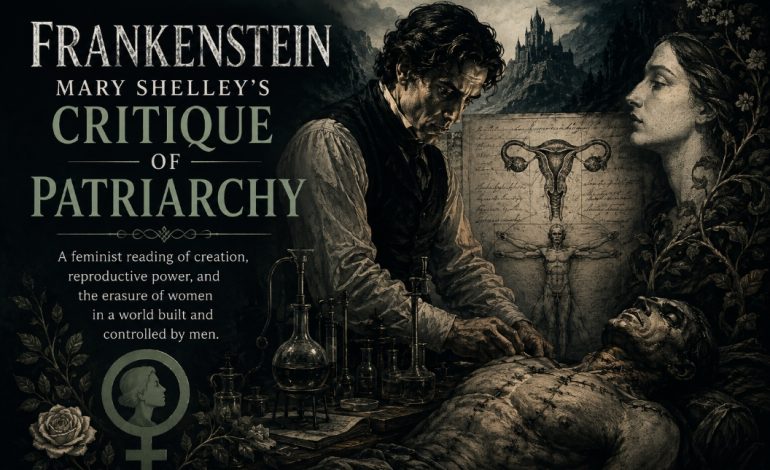

When readers think of Frankenstein, they usually imagine a grotesque creature stitched together from corpses, a mad scientist obsessed with defying death, or a Gothic tale about the dangers of scientific ambition. Yet beneath its horror lies a far more unsettling truth: Mary Shelley’s Frankenstein is a devastating biological critique of patriarchy.
Long before feminist theory gave us the language to describe reproductive politics, gendered power, and male control over women’s bodies, Shelley imagined a world where a man attempts to erase women from the very process of creation. The result is not merely a monster—it is catastrophe.
The Horror of Creating Life Without Women
Victor Frankenstein’s greatest transgression is not simply playing God. It is his attempt to monopolize creation itself.
Human reproduction has traditionally been the one sphere where female agency remains biologically indispensable. Victor seeks to overturn that reality by manufacturing life independently of women. His scientific project is therefore more than an experiment; it is an act of patriarchal conquest over nature and female reproductive power.
This idea has fascinated feminist critics for decades. Ellen Moers famously interpreted Frankenstein as a “female birth myth,” reflecting Mary Shelley’s own anxieties surrounding motherhood. Kate Ellis viewed the novel as a critique of the bourgeois family, while Sandra Gilbert and Susan Gubar argued that it dramatizes women’s profound alienation within a male-dominated society. Mary Poovey, similarly, saw the novel as exposing the powerlessness imposed upon women while simultaneously revealing the female writer’s struggle for creative expression.
Although these readings differ, they converge on one striking conclusion: Frankenstein is fundamentally a novel about patriarchal power.
Patriarchy Beyond the Household
Patriarchy in Shelley’s novel extends far beyond domestic authority.
Friedrich Engels described the patriarchal family as the nucleus of economic and social domination, where power is concentrated in the hands of the father. Kate Millett later expanded this understanding by defining patriarchy as a system of structured domination rooted in gender. Building on these ideas, feminist theorists have demonstrated how patriarchal societies regulate both women’s reproductive capacities and their economic independence.
Shelley transforms these abstract structures into lived experience.
Victor Frankenstein becomes the embodiment of patriarchal authority—not because he governs a household, but because he believes creation itself should belong exclusively to men.
Science as an Instrument of Patriarchal Control
The laboratory in Frankenstein is not merely a scientific space.
It is a political one.
Victor’s experiment symbolically invades and replaces the female body. His scientific ambition transforms nature into something passive, controllable, and exploitable—a resource to be mastered rather than respected.
Shelley exposes how technological progress, when divorced from ethical responsibility, can become another language of domination.
Victor does not seek partnership with nature.
He seeks ownership over it.
The nightmare he experiences immediately after animating the Creature becomes psychologically revealing. His triumph instantly collapses into horror because his attempt to seize reproductive authority has violated the natural balance of human existence. Creation without care produces only destruction.
Erasing Women from Creation
Perhaps the most disturbing pattern in Frankenstein is not who survives, but who is systematically excluded.
Victor creates only a male creature.
When the Creature demands a female companion, Victor destroys her before she can even exist.
The novel’s primary narrators—Victor, the Creature, and Robert Walton—are all men. Henry Clerval occupies the position of Victor’s closest intellectual companion. Women, meanwhile, are reduced to silent observers, sacrificial victims, or absent figures whose voices rarely shape the narrative.
This is not accidental.
Shelley constructs a world where male ambition repeatedly attempts to eliminate female agency, particularly in reproduction. Every attempt to erase women from creation results in death, isolation, and irreversible loss.
The destruction of the unfinished female creature is especially symbolic. Victor fears she may possess desires, choices, and autonomy beyond his control. Rather than allow an independent female existence, he annihilates her before she is born.
The act becomes one of the novel’s clearest expressions of patriarchal anxiety.
The Real Monster
Popular culture has long identified Frankenstein’s Creature as the monster.
Mary Shelley asks us to look elsewhere.
The novel suggests that monstrosity does not emerge from stitched flesh or unnatural birth. It emerges from a worldview that values domination over empathy, possession over partnership, and masculine authority over shared humanity.
Victor’s tragedy lies not in scientific curiosity but in his refusal to accept responsibility for the life he creates. His desire to replace women in the act of creation ultimately leaves him incapable of performing the nurturing role traditionally associated with parenthood.
He wants the power of creation without the labour of care.
That contradiction destroys everyone around him.
Why Frankenstein Still Matters
Two centuries after its publication, Frankenstein remains astonishingly contemporary.
As debates surrounding biotechnology, artificial intelligence, reproductive technologies, and genetic engineering continue to evolve, Shelley’s novel asks an enduring question: Who has the right to create life, and what happens when creation becomes an expression of power rather than responsibility?
Its answer is profoundly feminist.
The greatest horror is not scientific innovation itself. It is the patriarchal desire to monopolize creation, silence female agency, and mistake control for progress.
The Creature may be assembled from dead bodies, but the true monster is a system that believes life can flourish after erasing the women who have always made it possible.
Chandra, S. 2026
References
Vanessa D. Dickerson. “The Ghost Of A Self: Female Identity In Mary Shelley’s Frankenstein.” Journal Of Popular Culture 27.3 (1993): 79-91. International Bibliography. University of Arkansas Library, Fayetteville. Web. 3 Apr. 2015.
Linda Gill. “Women Beware! The Appropriation Of Women In Hollywood’s Revisioning Of Mary Shelley’s Frankenstein.” Journal Of American & Comparative Cultures 24.3-4 (2001): 93-98
London, Bette. “Mary Shelley, Frankenstein, and the Spectacle of Masculinity.” PMLA, vol. 108, no. 2, Modern Language Association, 1993, pp. 253–67, https://doi.org/10.2307/462596.
Hodges, Devon. “Frankenstein and the Feminine Subversion of the Novel.” Tulsa Studies in Women’s Literature, vol. 2, no. 2, University of Tulsa, 1983, pp. 155–64, https://doi.org/10.2307/463717.
Shohet, Lauren. “Reading Milton in Mary Shelley’s <em>Frankenstein</Em>.” Milton Studies, vol. 60, no. 1–2, Penn State University Press, 2018, pp. 157–82, https://doi.org/10.5325/miltonstudies.60.1-2.0157.
Purinton, Marjean D. “Ideological Revision: Cross-Gender Characterization in Mary Shelley’s ‘Frankenstein.’” CEA Critic, vol. 56, no. 1, The Johns Hopkins University Press, 1993, pp. 53–64, http://www.jstor.org/stable/26393693.
Moi, Toril. “From Femininity to Finitude: Freud, Lacan, and Feminism, Again.” Signs, vol. 29, no. 3, The University of Chicago Press, 2004, pp. 841–78, https://doi.org/10.1086/380630.
Olivier, Bert. (2005). Lacan’s subject: The imaginary, language, the real and philosophy. South African Journal of Philosophy. 23. 10.4314/sajpem.v23i1.31381.